AI Maestro for Wholesale & Distribution
We don't sell software: we professionalize how you use AI
In two months you know which parts of your wholesale operation AI pays off on and which it does not. You end with a map of how the warehouse, purchasing, routing and B2B customer service actually work, an opportunity score for each process and a recommendation of what to tackle first. Only then do you decide whether we build anything.
What is AI Maestro for wholesale and distribution?
AI Maestro for wholesale and distribution is Stage 1 of IQ Source’s AI discovery program applied to the work of wholesalers and distributors: consulting, education, and training to identify where AI adds value in a distribution operation before designing or building anything. It is not installing a tool; it is understanding your operation first.
A distributor’s work lives in inventory, thin margins, and a supply chain that does not forgive mistakes. We map the real flow of inventory and warehouse management, demand planning and purchasing, delivery routing and logistics, order processing and reconciliation, pricing and margins by channel, and B2B customer service, not the version in the handbook. We document the tribal knowledge of your warehouse, purchasing, and sales people before automating anything, and we draw a clear line between what an AI agent can assist with and what demands human judgment, B2B customer data, and continuity of the logistics operation.
Stage 1 delivers four artifacts: a Process Reality Map of your distribution operation, a Definitions Audit that flags where terms like "available inventory" or "backorder" mean different things across warehouse, sales, and logistics, an AI Opportunity Score, and an Opportunity Ranking with a Go/No-Go recommendation. Sometimes the conclusion is that a specific task does not need an AI agent but a classic automation or a process redesign, and that honesty is part of the value. With the artifacts in hand, your company decides whether to invest in Stage 2, where design and implementation happen.
The AIAD Framework
AIAD runs during Stage 1, typically 2 months of consulting, education, and training, and can extend with the size and complexity of your operation. It ends in a Solution Blueprint, and a Go/No-Go gate then decides whether Stage 2 builds it. In a distribution operation, every finding is also weighed against thin margins, the risk of stockouts, the sensitivity of B2B customer data, and the continuity of the supply chain.
Archaeology
Mapping the real work of warehouse, purchasing, sales, and logistics: inventory, demand planning, routing, orders, and reconciliation, not the wiki or the manual. Includes a definitions audit: where "available inventory" or "backorder" mean different things across warehouse, sales, and logistics.
Inquiry
One-on-one interviews and AI fluency training to pinpoint where AI helps and where your team stays in the loop.
Advisory
Scoring and ranking each opportunity by operational risk, margin impact, and return.
Design
Deliver a Solution Blueprint: the prioritized recommendation for inventory, demand planning, and routing workflows.
Decision gate · Go / No-Go
- Go
- Build it. Stage 2 is separate and conditional.
- No-Go
- Keep the human in the loop.
You decide. No pressure to build.
When the decision is Go, this is what Stage 2 builds: IQ Second Brain
A contractor builds exactly what you ask for: you get that, but it may not be what you needed. An architect studies how you operate before designing. Stage 1 exists precisely so you do not build the wrong thing.
What stays in your company
- Process Reality Map
- Definitions Audit
- AI Opportunity Score
- Opportunity Ranking and Recommendation
Diagnose where AI belongs, before you spend on it.
AI governance
Professionalizing how you use AI starts with the rules
Throughout the program we define with your team which data can travel to the models and which cannot, which tools are used and under what rules, and in which decisions a human stays in the loop. The platform recommendation is neutral: we take no commission from any vendor.
Related Case Studies
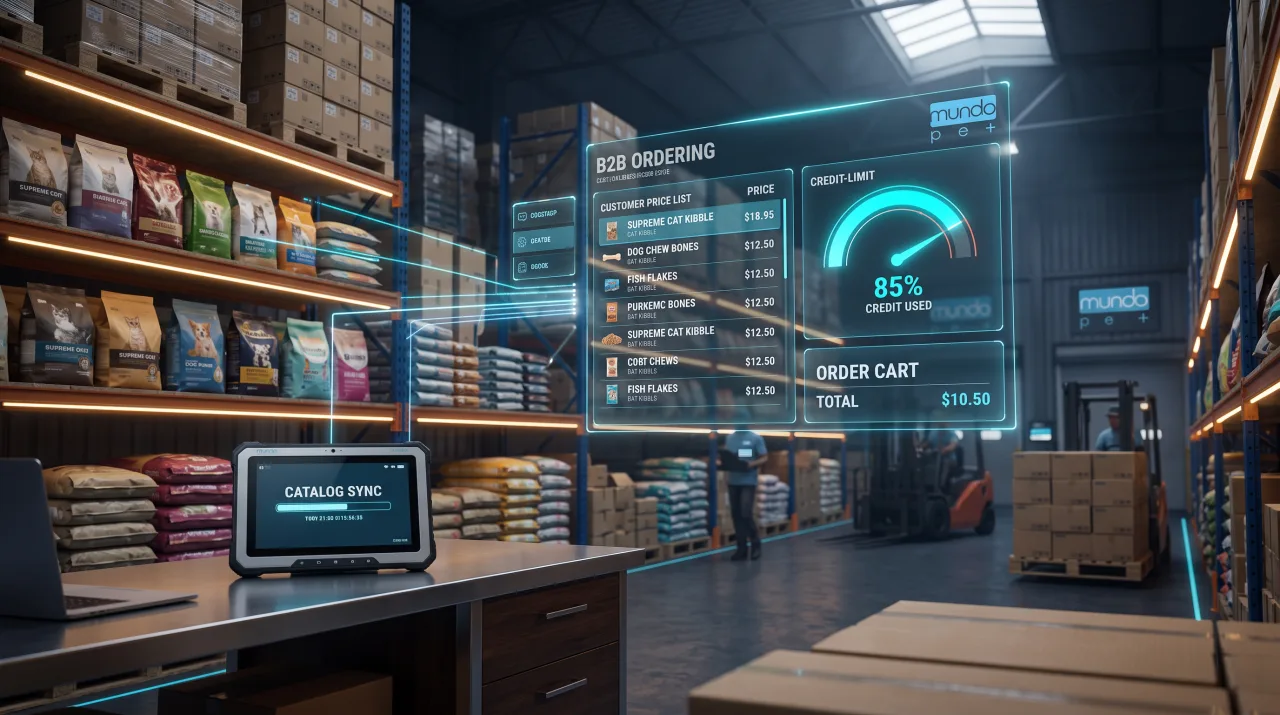

Mundo Pet E-Commerce
A B2B Buying Channel That Talks to SAP Business One
2,400+
products
15 min
ERP Sync
12
weeks delivery


Latin Health Group Healthcare
From Uncertainty to the Team Asking for More Seats
20 h
On-Site Training
9
Use Cases in Production
5 min
Sales Analysis
Before you talk to us
Not sure your company is ready for Stage 1?
The AI readiness assessment is 21 questions across seven dimensions and about five minutes. At the end you see your score per dimension and get a PDF report with your gaps and where to start. It is free and takes no call.
Take the assessment, 5 minFrequently asked questions
AI Maestro for wholesale and distribution is Stage 1 of IQ Source’s AI discovery program applied to the work of wholesalers and distributors: two months of consulting, education, and training to discover where AI makes sense in a wholesale and distribution operation before designing or building anything. It delivers a Process Reality Map, a Definitions Audit, an AI Opportunity Score, and an opportunity ranking with a Go/No-Go recommendation. Agent design happens later, in Stage 2, only if the gate justifies it.
Protecting B2B customer data and operational continuity are evaluation criteria in every opportunity, not an afterthought. In Stage 1 we classify what information an AI model may touch and under what conditions, and we draw the line between tasks an agent can assist and those that demand human judgment, especially where a mistake moves margins or stalls the supply chain. Stage 2 design incorporates access controls, data governance, and human review where the risk requires it.
Typical candidates in wholesale and distribution are demand planning and purchasing, inventory and warehouse management, delivery routing and logistics, order processing and reconciliation, pricing and margins by channel, and B2B customer service. Stage 1 does not assume which apply to your operation: it discovers them, prioritizes them by risk and return, and sometimes concludes that a specific process performs better with classic automation than with an AI agent.
No. The goal is to remove repetitive, low-judgment work so your warehouse, purchasing, sales, and logistics people spend their time on planning, B2B customer relationships, and the decisions that move margins. The program designs autonomy limits and human-review gates precisely so operational responsibility stays with your team.
Discovery typically lasts 2 months and can extend with the size of the operation. It delivers four concrete artifacts: a Process Reality Map of your distribution operation, a Definitions Audit, an AI Opportunity Score, and an Opportunity Ranking with a Go/No-Go recommendation. With those, your company decides, with evidence, whether to move to design and implementation.
It depends on what is already approved internally. Our reference tool for AI fluency training and discovery demonstrations is Anthropic Claude (Pro, Team, or Enterprise). If another tool is already approved, or internal policy does not allow cloud models, Stage 1 runs on what is approved and nothing new has to be bought to start. If Claude is used, licenses for the company’s designated participants are contracted directly with Anthropic and are not included in the program investment; IQ Source sizes with you how many and which tier based on the participating team.
Already bought an AI tool?
Buying the license and getting the team to change how it works are two different projects, and the second is the one almost nobody runs. Deloitte measured in January 2026 that 84% of companies have not redesigned a single role around AI. There is a section explaining, tool by tool, what each one covers and where AI Maestro fits in.
See AI Maestro and AI toolsTalk to AI Maestro
Fill out the form and an expert will contact you to discuss your needs