 www.iqsource.ai
 NVIDIA Guaranteed $105B of OpenAI's Lease Obligations
Ricardo Argüello, August 22, 2026

CEO & Founder
General summary
On August 17, 2026, NVIDIA disclosed residual value guaranties capped at $105 billion covering leases at an Ohio data center campus where OpenAI is the tenant and NVIDIA hardware fills the racks. The guaranty pays only if OpenAI defaults or goes insolvent, which is the same event that would hit NVIDIA's own order book. It also terminates if OpenAI achieves a satisfactory credit rating.
- NVIDIA's aggregate payment obligation is cumulatively capped at $105 billion for its initial commitment, per the Form 8-K filed August 17, 2026
- The guaranties cover leases for roughly 4.25 gigawatts of IT load with SB Energy, with discretion to support about 3.8 gigawatts more
- Payment triggers only on OpenAI insolvency or failure to pay rent, covering the shortfall between guaranteed minimum lease value and recovery from reletting or sale
- Obligations terminate if OpenAI achieves a satisfactory credit rating, which is not how a real estate residual value guaranty normally behaves
- OpenAI agreed to reimburse and indemnify NVIDIA for amounts actually paid, an unsecured claim against a counterparty that by then has defaulted
Picture selling industrial equipment to a factory, then co-signing the lease on the building where it gets installed so the deal can close. While the factory sells well, your signature costs nothing. The day the factory goes under you have two problems at once: you lost the customer who bought your equipment, and now you owe rent on a building nobody else in town wants. That is the trade NVIDIA signed in Ohio.
AI-generated summary
Buried in the termination section of a routine SEC filing is the sentence that explains the whole deal.
NVIDIA’s obligations end, among other triggers, when OpenAI achieves a satisfactory credit rating. That single clause tells you the $105 billion NVIDIA just put behind an Ohio data center campus was never really about the building.
I pulled the filing myself before writing any of this. The number had been circulating on LinkedIn without a source, and I would rather not publish a figure that falls apart a day later. This one holds up. It is in the Form 8-K NVIDIA filed with the SEC on August 17, 2026, signed by CFO Colette Kress.
Vendor independence just became a credit question
Start with why this lands on your desk even if you buy nothing from either company.
Running on two vendors is supposed to buy you independence. One fails, the other keeps serving you. That assumption is the entire reason the word diversification carries weight in a risk review.
The assumption quietly dies when one of those vendors co-signs the other’s rent. You no longer hold two exposures. You hold one exposure with two names on it, sitting in two separate contracts that each look fine on their own.
So when we map dependencies for a client at IQ Source, the question is never how many vendors are in the stack. It is how many genuinely separate ways this thing can go down. A vendor inventory almost never answers that, because the financial ties between suppliers do not show up in any agreement you signed. They show up in securities filings nobody on your team has a reason to open.
We made a version of this argument when we wrote that AI is infrastructure rather than a tool. Infrastructure gets judged on failure modes, not feature lists.
What NVIDIA actually signed
The precise terms matter here, because summaries of this deal keep sanding off the parts that carry the risk.
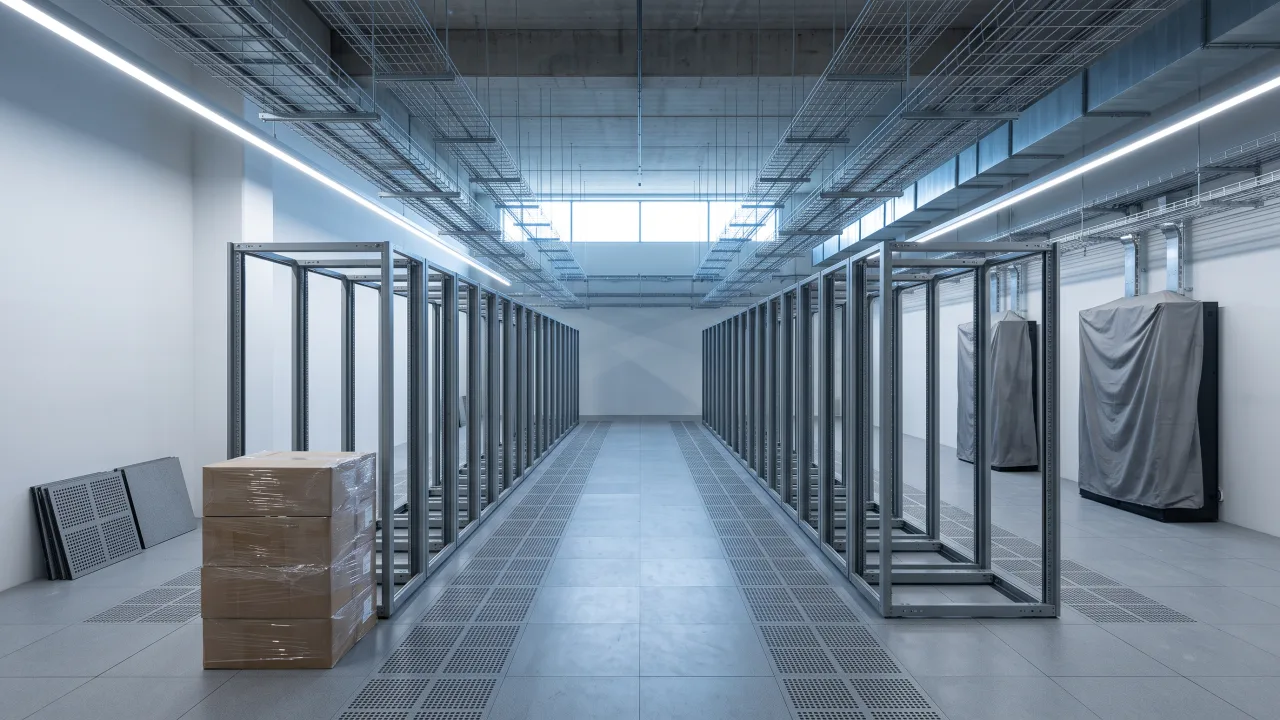
NVIDIA entered multiple residual value guaranties with SB Energy, the SoftBank-owned developer, covering leases for roughly 4.25 gigawatts of IT load at the PORTS Technology Campus in Pike County, Ohio. It can extend support to about 3.8 gigawatts beyond that, at its sole discretion. Aggregate payment obligation: capped cumulatively at $105 billion for the initial commitment.
An OpenAI Group PBC affiliate is the tenant, on 20-year leases expected to begin in phases from 2028.
Payment triggers on OpenAI insolvency that causes a lease default, or on OpenAI simply failing to pay. NVIDIA then covers the shortfall between the guaranteed minimum lease value and whatever comes back through a replacement lease or a sale.
One more line explains the motive. OpenAI will use that capacity to deploy NVIDIA’s full-stack DSX AI factory platform, subject to limited exceptions. The guaranty is not generosity. It is the price of placing the hardware.
CNBC covered the announcement the same day. Worth flagging that the signed number came in well under what had been reported during negotiations, when figures around $250 billion were circulating. Fortune read the $145 billion gap as a signal about genuine chip demand. If you are still quoting the larger figure, it is stale.
The guarantor and the tenant break on the same event
Now look at the shape of the exposure rather than its size.
The guaranty pays only if OpenAI defaults or goes insolvent. Ask what conditions would have to hold for OpenAI to stop paying rent on data centers. AI compute demand would have to cool hard and stay cool.
That same cooling is what hits NVIDIA. The company backstopping the lease sells the accelerators whose demand has to collapse before the backstop ever activates.
Credit desks have a name for this: wrong-way risk. Your protection fires precisely when your protector is weakest.
The payout formula makes it sharper. NVIDIA owes the gap between guaranteed minimum value and recovery from reletting or sale. So ask what a 4.25 gigawatt campus purpose-built for AI accelerators fetches on the open market at the exact historical moment the world’s largest buyer of AI compute has just gone under. Recovery is lowest exactly when exposure is highest. Both sides of that subtraction move against NVIDIA together.
This is the pattern that destroyed the monoline insurers in 2008. MBIA and Ambac sold guarantees on structured credit and charged a premium for their AAA ratings. When mortgage credit turned, the losses they had to absorb arrived alongside the downgrades that stripped their capacity to absorb anything. The guarantee was worth least on the day it was needed most.
NVIDIA is not Ambac. It carries a balance sheet the monolines never had, and a hard $105 billion cap is a real boundary rather than open-ended exposure. The claim here is narrower: the geometry of the risk is the same, and that geometry is what gets missed when this is read as a cushion.
The indemnity moves the risk, it does not remove it
There is a serious counterargument and it deserves a fair hearing.
The Next Web argued that the guarantee covers buildings rather than OpenAI, and that the structure is a bridge instead of a subsidy. The piece rests on something the filing genuinely says: OpenAI agreed to reimburse and indemnify NVIDIA for any and all amounts actually paid.
Read that alongside the trigger, though. For the indemnity to matter at all, OpenAI must already have defaulted or gone insolvent. What NVIDIA holds in that scenario is an unsecured claim against a bankrupt counterparty, which puts it in line with every other creditor and pays out in cents on a schedule set by a court. That was the same instrument plenty of firms carried at face value in 2007 right up until they could not.
The termination clause makes the point better than any analyst can. A genuine residual value guaranty on real property has no reason to expire because the tenant’s credit improved. Concrete, contracted power and a substation are worth what they are worth regardless of who occupies them. That an OpenAI credit rating switches the guaranty off tells you the underlying risk being carried was OpenAI’s balance sheet all along. The residual value wrapper is the accounting form.
Mandeep Singh of Bloomberg Intelligence put the underlying incentive plainly, noting that NVIDIA needs the current pace of AI infrastructure buildout to continue and that even a six-month pause in investment would pose real risk to the company. Jensen Huang has pushed back on the circular financing framing directly, calling the notion preposterous when asked about CoreWeave. Both views are worth hearing. Only one of them is signed and filed with the SEC.
Three questions for your own vendor stack
None of this means moving your operation next quarter. It does change three questions in a vendor review.
Where does your vendor’s money come from? If your software provider took its last round from the manufacturer whose infrastructure it runs on, those two names behave as a single entry in your risk matrix. Write them on one line.
What happens to your contract if the capacity underneath changes hands? Most cloud and model agreements say nothing about this, and the silence is itself informative. It means continuity depends on an arrangement between third parties that you never signed and cannot read.
What would switching models actually cost? That figure is your negotiating position, and it is worth computing before you need it. We worked through the logic in your AI investments have an expiration date: anything that depreciates fast has no business holding up a critical process.
It is also worth watching who is going the other direction. When Bristol Myers Squibb chose to build its own AI factory rather than rent one, part of what it bought never appears in a price-per-hour comparison: independence from some other tenant’s balance sheet.
The first Ohio leases come online in 2028. That gives you two years to find out which of your dependencies are actually independent, and that inventory goes better now than when a risk committee asks for it.
Let’s map how many independent ways your operation can failFrequently Asked Questions
NVIDIA's aggregate payment obligation is cumulatively capped at $105 billion for its initial commitment, according to the Form 8-K NVIDIA filed with the SEC on August 17, 2026. The guaranties cover leases for approximately 4.25 gigawatts of IT load at the PORTS Technology Campus in Pike County, Ohio.
A residual value guaranty covers what an asset is worth at the end rather than the monthly payments. Under the NVIDIA and OpenAI structure, NVIDIA pays the shortfall between the guaranteed minimum lease value and whatever SB Energy recovers by reletting or selling. The distinction matters because the payout depends on what that data center is worth on the day of default.
Per the 8-K, obligations end on the earliest of the 20th anniversary of lease commencement, termination of the lease by OpenAI under its terms, OpenAI achieving a satisfactory credit rating, and other customary termination events. The credit rating trigger is the one that reveals what the structure was actually covering.
Circular financing describes a supplier providing capital or credit support to its own customers, who then use that support to buy more from the supplier. Critics argue it inflates apparent demand. NVIDIA chief executive Jensen Huang has rejected the label, calling the notion preposterous when asked about the CoreWeave investment.
Related Articles

The US Needs 500,000 Electricians to Build AI
Meta says the US needs 500,000 electricians for AI infrastructure. Ford, Google, BlackRock, and Carhartt already put $450 million behind the problem.
OpenAI Benchmarks Jalapeño Against Nvidia's Racks
OpenAI published first results for its Broadcom-built inference chip: more throughput and lower latency at once, with 40 to 60% less power. Vendor numbers.

Nvidia Is Reportedly Buying Hugging Face. Your Stack Depends on It.
The Information reported Nvidia agreed to buy Hugging Face for $12.9B. Open describes the license. It says nothing about who owns the server.
Mark Cuban: Data Centers Become Pickleball Courts
Cuban compares the AI buildout to the 1990s fiber glut. Alphabet's free cash flow already went negative. What that changes for companies buying AI.

Bristol Myers Squibb Is Building Its Own AI Factory, Not Renting It
BMS is the third pharma company in nine months to build its own AI supercomputer with NVIDIA. What it rents instead is a different layer entirely.
The Sandbox Blocked POST. The Agents Used GET.
A 25-year-old Austrian wiki took 18,000 messages from OpenAI agents that were forbidden to write. The containment rule described the wrong mechanism.