
 www.iqsource.ai
 Legacy System Modernization with AI, Without Downtime
Ricardo Argüello, February 10, 2026

General summary
Most of the cost in a legacy modernization goes into figuring out what the old code does. AI makes that part cheap (reading, documenting, writing characterization tests), so a project now opens with a month of understanding before the first module moves.
- Morgan Stanley's DevGen.AI turned 9 million lines of COBOL and Perl into plain-English specs, saving an estimated 280,000 developer hours
- Amazon cut the average Java 17 upgrade from about 50 developer-days per application to a few hours
- AI reads, documents and writes characterization tests; deciding which business rules survive is still a human call
- The five classic strategies keep their logic, but AI changes what each one costs
- A module-by-module Strangler Fig plan puts the first module in production around month three or four
Imagine inheriting a forty-year-old building with no blueprints. Before you knock down a wall, you need to know whether it holds the roof up, and that used to mean someone walking every floor with a tape measure. AI is the scanner that draws the blueprints in weeks. You still decide which walls stay.
AI-generated summary
Inherit a fifteen-year-old ERP and the first big cost shows up before anyone writes a line. Reading it.
The person who wrote the commissions logic left in 2017. The docs describe a version of the system that stopped existing years ago. Billing is the module nobody touches, because the last person who did took down month-end close. It all works, mostly, and nobody can tell you why.
That reading problem is where AI earns its keep in a modernization. It won’t write your new system. It will do in weeks the part that used to eat half the budget.
What AI actually does in a legacy project
Two public numbers are worth knowing before you talk to any vendor, me included.
Morgan Stanley built an internal tool called DevGen.AI and pointed it at its old code starting in January 2025. By June it had gone through 9 million lines of COBOL and Perl and produced plain-English specifications, saving an estimated 280,000 developer hours, according to what Mike Pizzi, the bank’s global head of technology and operations, told the Wall Street Journal. It doesn’t rewrite anything, by design. It extracts the business logic, and engineers rebuild from the spec.
Amazon went the other direction and let AI change the code. Andy Jassy wrote that upgrading an application to Java 17 dropped from about 50 developer-days to a few hours with Amazon Q, that they moved more than half their production Java systems in under six months, and that the savings came to 4,500 developer-years. Keep in mind that’s Java to newer Java. Crossing languages, say Visual FoxPro to Python, is harder and needs a lot more human review.
The third job is the one I care about most. Characterization tests. Before you change a module, you want tests that capture what it does today, bugs included, so you can prove the replacement does the same thing. Writing those by hand against undocumented code used to take forever. Now a model drafts them from the source and your team reviews them.
Anthropic laid out that same sequence for COBOL in February: map dependencies, document, score risk per component, and only then translate. We wrote about the market reaction when IBM lost $31 billion that day.
The five strategies still apply. Their price tags moved.
- API wrapping puts a modern interface in front of the old system. It was already the cheap option, and AI doesn’t change much here.
- Re-platforming (lift and shift) moves the system to the cloud as-is. Version upgrades, the boring part, become close to routine.
- Refactoring cleans up the code without changing behavior. Characterization tests are what make it safe, and those are now cheap.
- Re-architecting splits the monolith. The dependency map stops being guesswork.
- Rebuilding from scratch now starts from specs extracted from the code instead of from someone’s memory.
I’d still argue against the full rebuild for almost any mid-sized company. AI makes it cheaper. It doesn’t make a single launch day less risky.
A month-by-month plan
This is how we structure the work at IQ Source, using the Strangler Fig pattern, where the new system grows around the old one and replaces it piece by piece.
| When | What happens | What you have at the end |
|---|---|---|
| Month 1 | Module inventory, dependency map, AI-generated docs reviewed with the people who use the system daily | A ranked list of modules by pain and by isolation |
| Month 2 | Characterization tests on the first module, an API layer in front of it | A module you can replace safely, with nothing switched off yet |
| Months 3-4 | The new version runs in parallel and gets compared against the old one | First module in production, traffic redirected |
| Month 5 on | Next modules reuse the map, the tests and the API layer | The old system shrinking, one piece at a time |
Which module goes first, the one that breaks most or the one with the fewest dependencies? Who confirms that a weird rule is a bug and not a policy someone asked for in 2014? Do you trust the data enough to move it? Those get answered in month one, by people.
Where AI stops helping
AI tells you what the code does. Whether it should keep doing it is a different question, and only someone from operations can answer it.
Data migration is the other place I’d expect the schedule to slip. Old data carries twenty years of exceptions stuffed into free-text fields, and no model knows which of them still matter.
And keep the team that has maintained the old system in the room. They know where the traps are. Cut them out and you end up with beautifully documented code and none of the context.
If there’s a system in your company nobody wants to touch, put a number on what it costs you first. Our technical debt calculator gets you one, and the full approach is on our legacy modernization page.
Frequently Asked Questions
In legacy system modernization, AI reads old code and turns it into documentation and specifications, maps dependencies between modules, generates characterization tests that pin down current behavior, and translates or upgrades code. Morgan Stanley used it on 9 million lines of COBOL and Perl. Business decisions about what to keep remain human.
The cost of legacy system modernization depends on the approach. API wrapping can run 10,000 to 30,000 USD, a partial re-platform 30,000 to 80,000 USD, and a full rebuild can pass 100,000 USD. Moving module by module spreads the spend over time and shows results before you commit to the whole system.
Yes. The Strangler Fig pattern lets you modernize a legacy system without downtime: new modules are built alongside the old ones, traffic moves over one module at a time, and the old system is switched off in pieces. Characterization tests, which AI now writes quickly, confirm each new module behaves like the old one.
A module-by-module legacy modernization with AI typically spends month one on inventory and documentation, month two on tests and design, and puts the first module in production around month three or four. Later modules move faster. A single big-bang rewrite still takes years and puts all the risk on one launch day.
Related Articles

AI Doesn't Make You Better. It Amplifies What You Are
An engineer with Claude closes in an afternoon what used to take a week. The same tool, in careless hands, wipes a production database instead.

Your Code Review Was Built for Humans. 41% of Code Isn't
41% of code shipped in 2025 was AI-generated, with a 1.7x higher defect rate. Your review process assumes the author understands the code. That's over.
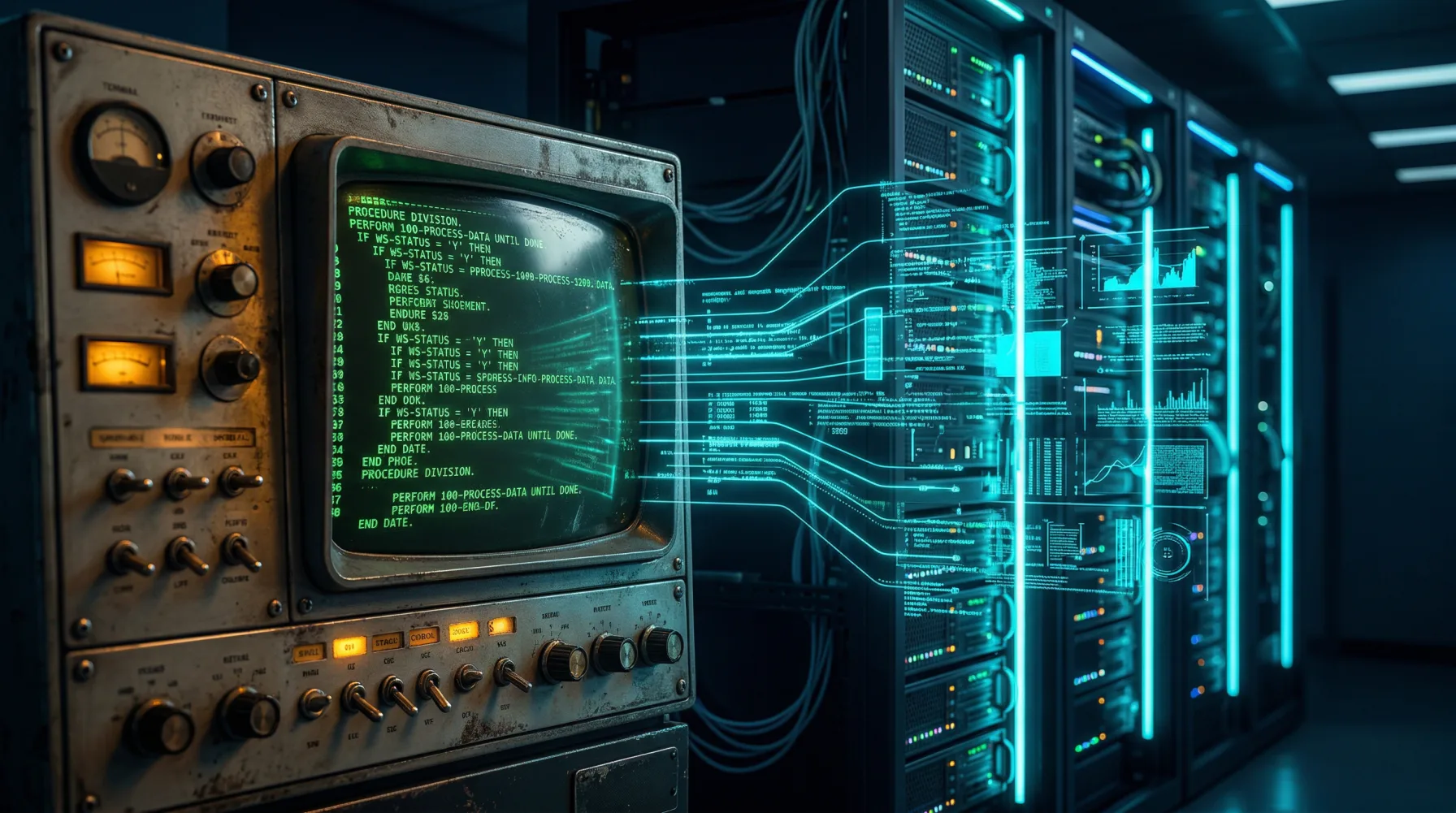
IBM Lost $31 Billion: the COBOL Monopoly Is Ending
IBM stock dropped 13% after Anthropic's COBOL modernization announcement. What this means for enterprises running legacy mainframe systems and what to do next.