 www.iqsource.ai
 Starbucks Retires AI Inventory Tool After 9 Months in 11,000 Stores
Ricardo Argüello, May 23, 2026
CEO & Founder
General summary
On Monday, May 19, 2026, Starbucks told employees internally that its NomadGo-powered automated inventory counting was being retired across more than 11,000 North American stores, nine months after the September 2025 nationwide rollout. The vendor had promised 99% accuracy and 8x speed. Nobody pressure-tested that number against an actual coffeehouse at peak. The tool confused milk types, missed bottles, and in Starbucks' own launch video failed to recognize a peppermint syrup bottle as it counted the bottles next to it. Before any operational AI deployment, IQ Source's AI Maestro measures effective accuracy against the real floor, not the vendor demo.
- Starbucks retired NomadGo's automated inventory counting tool across 11,000 North American stores on Monday May 19, 2026, nine months after the September 2025 nationwide rollout.
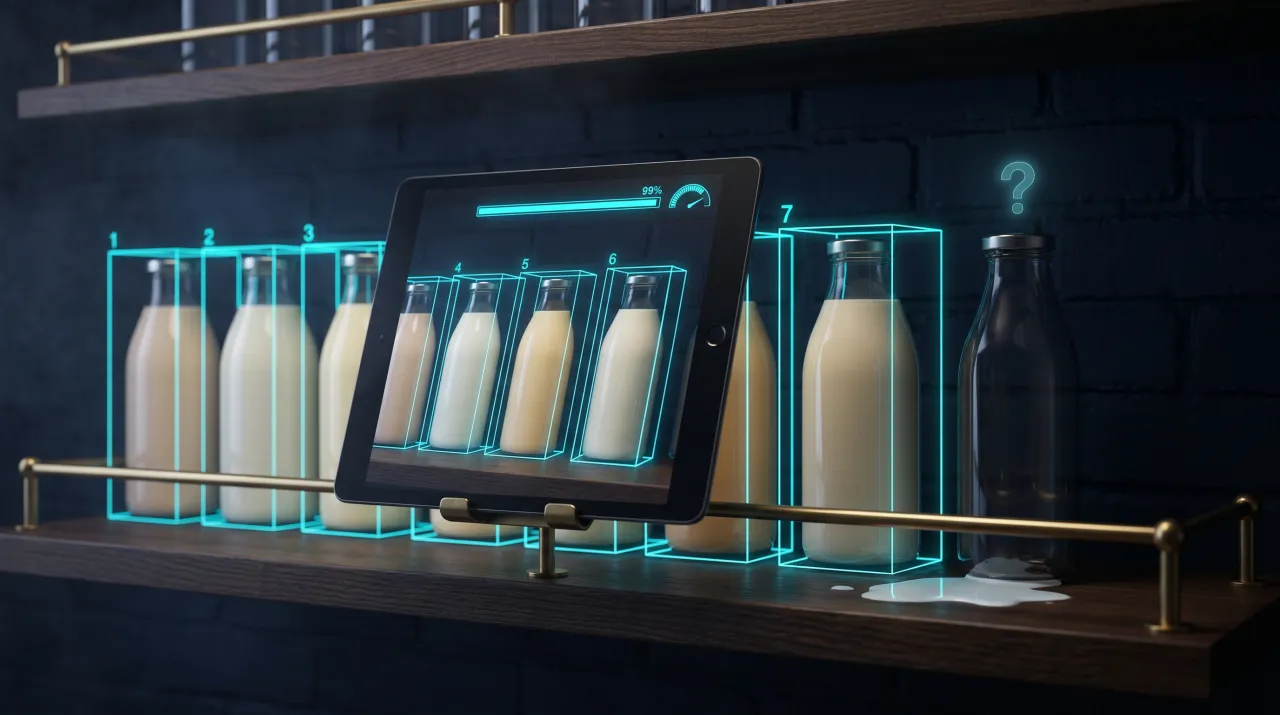
- NomadGo promised 99% accuracy and counts up to 8x faster than manual. Nobody independently verified that number against an actual Starbucks at peak operating conditions before scaling.
- The tool confused similar milk types, missed bottles, and in Starbucks' own launch video failed to recognize a peppermint syrup bottle on a shelf. Reuters reported the accuracy problem in February 2026, five months before the formal retirement.
- CEO Brian Niccol did not abandon AI. The same week NomadGo was retired, the rollout of Green Dot Assist (a conversational assistant built on Microsoft Azure OpenAI) continues to expand from the June 2025 pilot at 35 locations.
- Starbucks joins Klarna, Air Canada and McDonald's drive-thru on the list of enterprise AI pilots retired between 2023 and 2026. IQ Source's AI Maestro answers the operational question that should precede any deployment: which specific task does this agent amplify at the accuracy level the floor actually requires?
Picture this. Your vendor promises 99% accuracy in a controlled demo. You buy it, deploy across 11,000 stores, and nine months later your employees are doing double work because the AI confuses oat milk with whole milk. Your team burned nine months, lost the trust of the floor, and is now back to manual counting. That is exactly what Starbucks announced on Monday. The question is not whether AI fails. The question is why your organization measured accuracy against the vendor's demo instead of against your own operation at peak.
AI-generated summary
Corey Quinn, chief cloud economist at the Duckbill Group, put it in one line on Thursday: “Starbucks ran an AI inventory system for nine months before shutting it down because it couldn’t actually count or label items. Letting a hallucinating model dictate physical supply chain orders for three fiscal quarters? This seems production grade.”
That is the sharpest framing of the week because it names the real problem. It is not that AI failed. It is that nobody measured accuracy against the actual floor of a Starbucks before scaling to 11,000 stores.
The problem is not the AI. It is who measured the accuracy.
On Monday, May 19, 2026, Starbucks sent an internal newsletter: “Starting today, Automated Counting will be retired. Beverage components and milk will now be counted the same way you count other inventory categories in your coffeehouse.” Reuters broke the exclusive on Wednesday, May 21. Nine months after the nationwide September 2025 rollout.
The vendor claim is the number that matters. NomadGo, a Redmond, Washington, startup, had pitched 99% accuracy and counts up to 8x faster than manual on a tablet using computer vision, 3D spatial intelligence and augmented reality. Deb Hall Lefevre, the Starbucks CTO, cited that promise as the justification for the deployment.
Nobody asked for the demo under actual operating conditions. Nobody measured 99% against a packed store on a Friday at 7:45 in the morning, with similar milk types on adjacent shelves, shifting light, refrigerators opening every twenty seconds. That measurement was not done by the baristas either. The tablet shipped. The vendor deck stayed in the deck. Eleven thousand stores got the rollout in weeks.
The line Niccol used to launch the tool sounded operational, not demo-ware: “This technology streamlines a critical but time-intensive task.” The implicit condition (that the streamlining would survive the real operational floor) was never verified before scaling.
What broke at the bar
Reuters reported in February 2026 that the tool confused similar milk types, missed bottles, and in the official launch video that Starbucks uploaded to its own channel failed to recognize a peppermint syrup bottle while counting the bottles next to it. Starbucks deleted the original announcement page. The video with the failure kept circulating.
Benjamin Angel, writing for Warehouse Automation the day after the retirement, put the failure mechanism plainly: “When automation makes a worker’s job harder and more confusing, it has failed.” The effective accuracy was not 99%. It was low enough that every scan needed human verification, and a system that requires human verification of every output does not automate anything; it doubles the task.
The floor learned this in weeks, not nine months. Baristas on Reddit described it without the corporate filter: “It’s frankly impressive how bad it actually is.” The formal organization took nine months to react because the decision to retire it had to climb through layers that were not measuring real accuracy, they were measuring rollout progress against the corporate calendar.
That is the gap that matters for your operation. When the metric traveling upward is “percentage of stores with the tool deployed” and not “net counting time after manual corrections,” the tool can be failing entirely and still show green on the executive dashboard.
The pattern your CFO is already watching
The structural number that frames the Starbucks decision is not from Reuters. It is from the MIT NANDA Initiative: 95% of generative AI pilots delivered no measurable financial impact, despite $30-40 billion in spending. Starbucks joins a pattern that the 95% utilization gap post covered weeks ago and that now has a physical store as evidence.
Stephen Klein on Substack calls it “the AI Layoff Boomerang”. His list of recent retreats: Klarna rehired humans after taking customer service headcount from 5,500 to 3,400; Air Canada was found liable for a chatbot that fabricated a refund policy; McDonald’s killed its drive-thru AI order taker after three years of persistent errors. Starbucks is the most visible retail case of 2026, but not the first, and not the last.
The pattern repeats outside the bar too. Yesterday’s post on ClickUp’s $1M bands and Microsoft canceling Claude Code covered another face of the same problem. There, token cost made the agent unsustainable. Here, effective accuracy made the tool unsustainable. Different axes, same root cause: the deployment decision was made before the measurement that would have stopped it.
Your CFO is already reading Reuters. The next question is not theoretical. It is: which AI pilot do we have deployed today where the metric traveling upward is adoption rather than net result after corrections?
Niccol did not abandon AI. He changed which AI.
The easiest misreading this week is to conclude that Starbucks gave up on AI. It is not what happened. The same Brian Niccol who signed off on the NomadGo retirement continues the rollout of Green Dot Assist, a conversational assistant built on Microsoft Azure OpenAI. The pilot started with 35 stores in June 2025 and is expanding in fiscal 2026 to more locations across the United States and Canada.
The difference between Green Dot Assist and automated counting is not the technology. It is the acceptable failure mode. A conversational assistant that says “I’m not sure” or suggests an incorrect fix is corrected by the barista in the next second, and the cost of error is low. A counting system that reports “there are 14 bottles” when there are 12 distorts reordering, depletes store inventory, loses sales, and imposes a verification cost that cancels the time savings.
That is the read your team needs to do before approving the next purchase. It is not AI yes or AI no. It is: is the failure mode of this agent recoverable in the next second by the operator using it? If not, the accuracy the vendor promises has to be verified on your floor, not in their lab, before scaling beyond the controlled pilot.
Niccol learned the lesson between one and the other. He learned it the slow way. The difference matters to whoever is watching: the shareholder, the CFO, the operations team.
The acceptance test almost nobody runs
The concrete operational question that closes this week is just one. Before deploying AI into any bar, counter, plant, or floor process, who ran the 90-day acceptance test with the line workers measuring effective accuracy under real operating conditions?
Not the innovation team, not the vendor, not HQ. The line workers, the group that will use the tool every day, measuring for 90 days under real load. If that measurement does not exist or was done only in a lab or in controlled pilot stores, what you have is not a deployment ready for 11,000 locations. You have a vendor promise that survived a demo.
That test is the concrete deliverable the Process Reality Map of IQ Source’s AI Maestro is designed to produce before the deployment, not after. Two months of discovery that identify, process by process, which floor realities will break which AI assumptions. The output is an AI Opportunity Score and an explicit Go/No-Go gate. The deployments that pass the gate are those where the effective accuracy in real conditions closes against the acceptable failure mode for that specific task.
Niccol lost nine months on this, deleted the announcement page, and still has an official video with the failure circulating, all to learn the lesson. Your organization does not need to repeat that chain. The concrete opportunity this week is to pick one operational process, just one, where a vendor has promised accuracy in a demo, and before signing the purchase, run the measurement on your floor with the real operators for 90 days.
If the number holds, you scale. If it does not hold, you saved the cost of a public retirement.
Run the acceptance test before scalingFrequently Asked Questions
Starbucks retired the NomadGo automated counting system on May 19, 2026 because it confused similar milk types, missed bottles, and forced baristas to verify every scan, canceling the time savings the tool was supposed to deliver. Reuters reported the accuracy problems in February, five months before the formal retirement. The official statement spoke of standardizing inventory counting, not accuracy failures.
NomadGo promised 99% accuracy and counts up to 8x faster than manual when it announced the rollout to more than 11,000 Starbucks locations in September 2025. That number was not independently verified against real operating conditions in an actual coffeehouse at peak before scaling across North America. The operational audit came nine months too late.
No. Brian Niccol retired the NomadGo automated counting tool but continues the rollout of Green Dot Assist, a conversational assistant built on Microsoft Azure OpenAI. The pilot started with 35 locations in June 2025 and is expanding in fiscal 2026. The change is not between AI and no AI, it is between deployments that survived contact with the operational floor and those that did not.
AI Maestro is a two-month discovery program that measures the accuracy of an AI agent against the real operating floor, not against the vendor demo. The deliverable is a Process Reality Map, an AI Opportunity Score, and an explicit Go/No-Go gate. The deployments that pass the gate are the few where the accuracy math closes against the acceptable failure mode for that specific task, before scaling, not after a public retirement.
Related Articles
Amazon Just Walk Out and the humans behind the cameras
A 2024 report about Amazon Just Walk Out is circulating again on LinkedIn this week. The lesson for anyone buying AI automation still holds.
Uber: 50+ Approvals per Session, Zero Real Oversight
Uber open-sourced ADR after admitting its own tools could not see what its agents did. The finding: approving 50+ actions per session is not real oversight.

Anthropic gave Figma three days' notice before competing
Anthropic's chief product officer resigned from Figma's board on April 14. Three days later, Anthropic launched Claude Design, its direct competitor.