 www.iqsource.ai
 From Cassette Tapes to AI: 36 Years of Learning
Ricardo Argüello — March 18, 2026
CEO & Founder
General summary
Ricardo Arguello turns 50 and looks back at 36 years in technology: from programming on a Texas Instruments and saving code to cassette tapes, to co-founding Word Magic Software at 15, watching Google Translate disrupt them, and founding IQ Source in 2025 — inheriting projects and decades of experience. A personal story about technology cycles, the most expensive lesson he learned, and why the question remains the same.
- At 12-13 years old, he programmed on a Texas Instruments connected to a TV set, saving programs to audio cassette tapes — no hard drive, no internet, no safety net
- At 15, he co-founded Word Magic Software with his father: a translation and dictionary software that thrived for years until Google Translate and similar tools overtook them
- The Word Magic lesson: technology cycles don't send warnings, and the complacency of success is the biggest threat to any tech company
- Word Magic evolved from DOS to Windows to apps featured by Apple worldwide, but Google Translate changed the rules of the game
- 36 years later, the question remains the same as at age 14: what can I build with this?
Imagine you're 13 years old and the only way to save the program you just wrote is on an audio cassette tape. You press play, wait, and pray the tape didn't lose the data. That discipline — thinking before executing, because every mistake cost minutes of reload time — is the same discipline Ricardo applies today when helping B2B companies decide what to build with AI and what to skip.
AI-generated summary
Today I turn 50. It’s one of those numbers that makes you run through the highlights reel in your head, fast, like skimming through key moments before a long flight. And when I do that count, I always end up at the same place: a television set, a computer the size of a briefcase, and an audio cassette tape.
I started programming 36 years ago. Not in a Silicon Valley garage. In the living room of my house, in Costa Rica, plugging cables into a TV that also served for the evening news.
This is that story. It’s not a CV or a pitch. It’s more like what I’d tell a friend over coffee if they asked how I ended up doing what I do.
A birthday gift that changed everything
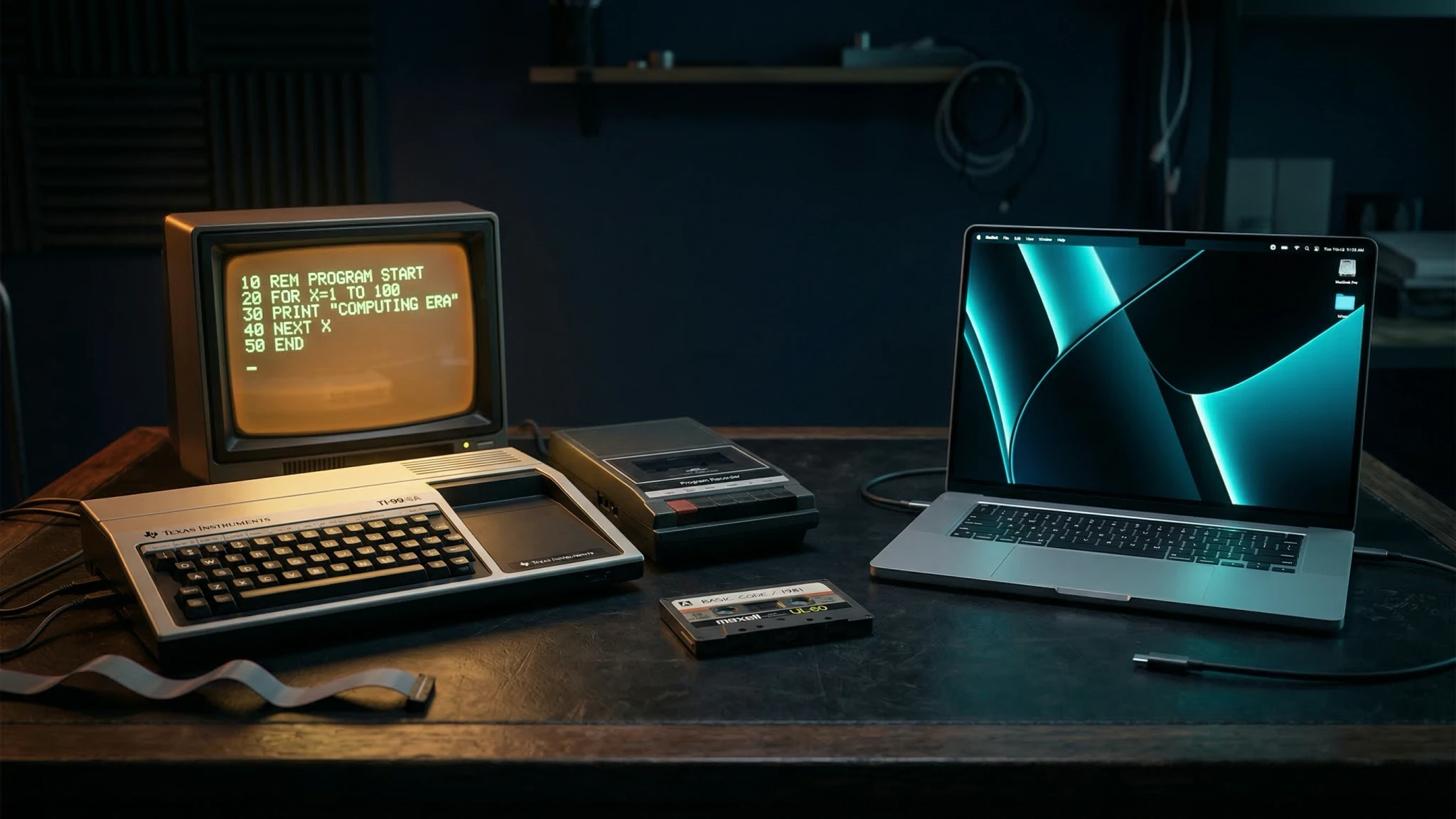
It all started with a Texas Instruments — a TI-99/4A, to be exact. You connected it to the TV with a coaxial cable and programmed in BASIC. It had no hard drive. No floppy disk. The only storage medium was an audio cassette tape connected with an auxiliary cable.
I was 12 or 13 years old. And back then, programming meant something very different from what it means today.
You wrote your code line by line, hit SAVE, and the computer turned your program into sound — literally, an audio signal recorded onto a cassette tape. To retrieve it, you rewound the tape, hit LOAD, and waited. Sometimes two minutes. Sometimes five. And at the end, it could fail because the tape had stretched, or because someone had recorded a Guns N’ Roses track over it.
There was no Control+Z. No previous versions. If you lost the program, you rewrote it from scratch. And you lost it often — power outages, damaged tapes, accidentally recording over your own work. There were programs I rewrote dozens of times.
That constraint taught you something no modern programming course teaches: to think before you write. Every line had to count, because the cost of a mistake wasn’t an error message on screen — it was half an hour of your life rewriting what the tape had eaten.
Saving code to a cassette and praying
It sounds quaint now, but that was reality. The ritual was always the same: you finished coding, connected the cable to the cassette recorder, pressed RECORD and PLAY at the same time, and executed SAVE. The computer emitted a high-pitched screech for a couple of minutes — that was your program turning into audio.
Then came the faith part. You rewound, hit LOAD, and stared at the screen waiting for “READY” to appear. Sometimes it did. Sometimes it didn’t. And when it didn’t, there was nobody to complain to.
It might seem like a minor detail, but that uncertainty — not knowing if your work would survive the save process — shaped me more than any university degree. It taught me a few things no classroom ever could: everything you build is fragile, and today’s technology is never forever. If your entire process relies on a single, failure-prone copy, you don’t have a process — you have a bet.
What my dad saw before I did
For my 14th birthday, in 1990, my dad gave me an XT computer. An IBM compatible with a hard drive, a green phosphor monitor, DOS. For the time, the leap was generational. Suddenly I was working with a hard drive instead of a cassette tape, a dedicated monitor instead of the family TV. Then came amber, CGA, EGA, and finally VGA — each upgrade felt like an event. I had left the simple world of BASIC on a TI for an environment where you could build real things.
My dad is an electrical engineer — nothing to do with computers, but he is an engineer. He saw something. He saw that his son spent hours in front of a television typing commands and wasn’t doing it out of obligation. And he decided to bet on that.
A year later, at 15, we co-founded Word Magic Software. A translation and dictionary software for English-Spanish that started as a DOS program. We built the product together. It was my first company, my first real experience of creating something that other people used and paid for.
Word Magic worked. Well. For years. It evolved from DOS to Windows and then to apps — apps that Apple featured worldwide. We had clients across Latin America and the United States, a growing product catalog, a stable operation. It was the kind of success that makes you think you’ve found your place.
And that’s the problem.
The day Google ran right past us
I don’t remember the exact moment. It wasn’t a single day — it was a process. Google Translate kept improving, online translation tools started multiplying, and suddenly what we were selling — desktop software you installed on your machine — started looking like an anachronism.
Our product hadn’t stopped working. The market had simply stopped needing it.
That’s the part that’s hard to accept. You can have a solid product, loyal customers, a working operation. And one day you realize the ground shifted beneath your feet while you were looking the other way.
Word Magic taught me the most expensive lesson of my career: technology cycles don’t warn you. They don’t send a memo. They don’t give you a six-month transition period. They just happen, and you find yourself on the other side wondering how you didn’t see it coming.
The answer, of course, is that you did see it. But when something works well, the inertia of success is stronger than any warning signal. You tell yourself “that doesn’t apply to my market,” that “my customers are loyal,” that “our product quality protects us.” And while you’re saying that, the world changes.
If you ran a video rental store in 2005, you didn’t need someone to explain what Netflix was. You knew. You just thought you had more time.
Every five years, everything you know becomes obsolete
After Word Magic came AppSourcing, SalesMachine, and impaKt Sales Inc. Some were eventually absorbed into IQ Source, and one — impaKt Sales — is still running today. Each project was a reset. Each one forced me to learn something new and — harder still — to let go of what I already knew.
Along the way, I studied Systems Engineering at TEC — the Costa Rica Institute of Technology — and later completed an MBA at Universidad Latina de Costa Rica. The combination of technical and strategic wasn’t a deliberate plan; it was the need to understand both sides after watching a good product without an adaptation strategy vanish.
Looking back, I lived through at least six major technology shifts up close:
- DOS → Windows: we went from memorizing commands to the simplicity of clicking an icon.
- The rise of the Web: software stopped being installed on every machine and became accessible through a browser.
- The Cloud leap: buying servers? No — now you rented capacity on demand.
- Waterfall → Agile: we abandoned rigid long-term plans for the ability to iterate every two weeks.
- The Mobile revolution: design stopped thinking about large screens and started centering on the device in your pocket.
- And now, artificial intelligence (AI): it’s no longer about writing every line of code — it’s about collaborating with models that generate it.
Each of those cycles left companies behind. Companies that were good at what they did, but didn’t adapt in time. Not because they were incompetent — because they were busy being successful in the previous cycle.
And that’s the real trap. Your own success becomes the anchor that keeps you from jumping to the next cycle. You cling to the evidence that your model works, ignoring that every model has an expiration date.
In our experience at IQ Source, the companies that handle these transitions best aren’t the ones with the biggest technology budgets. They’re the ones with the humility to accept that what worked yesterday probably won’t work tomorrow. And the discipline to act before the evidence is obvious — because when the evidence is obvious, it’s already late.
If your company depends on systems or processes that haven’t changed in five years, that doesn’t mean you have stability. It means you’re accumulating technical and organizational debt. Legacy system modernization isn’t an IT project — it’s a survival decision.
The same question, 36 years later
I founded IQ Source in November 2025. It inherited AppSourcing’s projects and all the experience accumulated over decades. And the reason it exists — honestly — is Word Magic.
Not because Word Magic was a failure. It was a real success that taught me something no MBA ever would: success blinds you, the technology you master today will be replaced, and the only lasting advantage isn’t knowing how to use a tool — it’s knowing when to let it go.
IQ Source exists because I lived what happens when you don’t adapt. And because after living it, I decided my work would be helping other companies see it before it happens to them.
Today the tool is called AI. Tomorrow it’ll be called something else. What doesn’t change is the question I’ve been asking myself since age 14, sitting in front of that TI-99/4A: what can I build with this?
At 50, I still don’t have the complete answer. And that’s fine. Because the point was never having the answer — it was keeping the question alive.
Tools are temporary. Questions are what stay.
There’s no YouTube recipe that tells you when your business model is about to expire. There’s no template for deciding which technology to adopt and which to ignore. That takes judgment, experience, and the willingness to be uncomfortable.
If you’re grappling with where a new technology fits in your business — debating whether to invest now or wait, trying to decide if the problem is your tools or your team’s mindset — that’s the conversation I’ve been having for 36 years. And the one I enjoy most. Let’s talk.
Frequently Asked Questions
Ricardo Arguello founded IQ Source in November 2025, inheriting projects from AppSourcing and decades of experience in technology. He started programming at age 12 on a Texas Instruments and co-founded Word Magic Software at 15 with his father — a product that evolved from DOS to Windows to apps featured by Apple worldwide. The experience of watching Google Translate disrupt Word Magic taught him that adapting to technology cycles matters more than any single product.
Word Magic Software was a successful translation and dictionary business co-founded by Ricardo Arguello and his father in 1991. When Google Translate and similar online tools gained traction, Word Magic didn't adapt fast enough. The lesson: success breeds complacency, and technology cycles don't wait. It's the same reason IQ Source today helps B2B companies anticipate disruptions instead of reacting once it's too late.
Over 36 years, Ricardo Arguello has lived through at least six major cycles: DOS to Windows, client-server to web, on-premise to cloud, waterfall to agile, web to mobile, and now manual coding to AI. Each cycle replaces tools and forces relearning. The B2B companies that survive are those that redesign operations around the new reality rather than waiting for the previous cycle to stop working.
IQ Source is a B2B consultancy founded in November 2025 that helps companies implement digital transformation and artificial intelligence. It inherited projects from AppSourcing and decades of its founder's experience with technology cycles — from desktop software to cloud and AI. Rather than selling technology, IQ Source diagnoses what needs to change in business operations and designs the path to implement it.
Related Articles

IBM Lost $31 Billion: the COBOL Monopoly Is Ending
IBM stock dropped 13% after Anthropic's COBOL modernization announcement. What this means for enterprises running legacy mainframe systems and what to do next.

AI Beyond Engineering: A Guide for Every B2B Team
AI isn't just for developers. Specific playbooks for Marketing, Finance, Sales, HR, and Operations with 90-day adoption plans for each team.